
What Is the Difference Between Structured Content and Vibe Coding?
Vibe coding describes producing content, a webpage, a document, a marketing email, a customer notice, by repeatedly prompting an AI and accepting whatever comes back, judged mainly on whether it looks right. Structured content follows a documented standard before the first piece is produced, whether a human or an AI does the writing.
The difference is not about who produces the content; it is whether a decision gets made once and followed, or re-derived from scratch with every prompt.
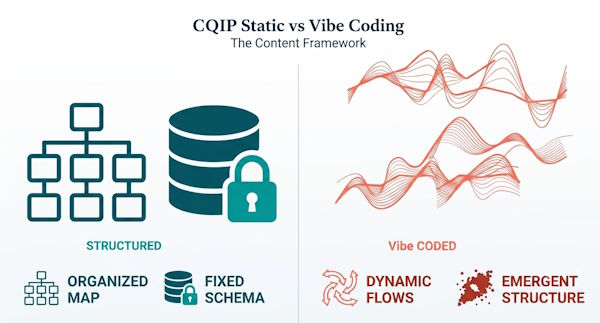
What Changes When a Standard Exists
Each new prompt in an unstructured AI-assisted workflow can make different undocumented choices, since nothing from earlier sessions is written down anywhere.
Structure that machines and downstream systems can actually read is whatever an AI happened to include in that one response, often inconsistent or missing entirely.
Coverage for required disclosures, accessibility requirements, or approved terminology depends on whether a specific prompt happened to include it, and gaps are easy to introduce and hard to catch before publication.
Two Ways to Produce Content, One Real Question
Structured content, built by hand, means someone follows a documented standard, terminology, required components, formatting, structure, and produces each piece against that standard. Structured content, built with AI assistance, changes who does the writing but not the standard being followed: terminology, required disclosures, and structural conventions are all defined in advance, in a document the AI is required to follow rather than improvise. Vibe coding is different in kind, whether the output is a webpage, a document, a marketing email, or a customer communication. A person prompts an AI toward a goal, accepts the result if it looks right, and moves to the next prompt. There is usually no standard governing what the next piece should contain, what it must disclose, or how it should be structured. Each prompt effectively re-derives its own answer to those questions.
None of this makes vibe coding the wrong choice in every context. For a single piece with no lasting consequence, a draft meant to test whether an idea is worth developing properly, or work with no intention of reuse, the overhead of a written standard is not worth paying. Vibe coding's real advantage, speed with no upfront planning, matters in those situations. The problem tends to show up later, not in the first piece. As output accumulates, each new piece is a fresh prompt with no memory of how the last one was produced, so small inconsistencies build: one piece carries a required disclosure and the next does not, one follows approved terminology and the next drifts, formatting changes without anyone deciding it should. Nobody, including the person who produced it, can say with confidence what the current body of content actually contains without rereading all of it.
This is the position worth stating plainly, because it is not manual versus AI; it is AI directed by a standard versus AI left undirected. An AI can produce content exactly as fast working inside a documented standard as it can without one. The difference is that the constraints it works within, what must be disclosed, what terminology is approved, how the content should be structured, are fixed in a document rather than reinvented per prompt. The speed of AI generation stays. The consistency of a written standard stays too. Neither has to be given up for the other.
For regulated organisations, this is not an optional refinement. Financial services, healthcare, legal, and similarly accountable sectors produce content that carries obligations beyond looking professional: required disclosures, accessibility compliance, approved terminology, a defensible record of who approved what and when. A standard that exists only in someone's memory does not survive staff turnover, an AI-assisted shortcut, or an audit. But the principle extends well beyond regulated industries. Standards matter to any responsible business that wants to know, with confidence, what its own content actually says and whether it still says what it is supposed to. Regulation simply makes the cost of skipping a standard visible sooner.
The choice is not really about who, or what, produces the content. It is whether a decision, what must be disclosed, what terminology is approved, what counts as a minor revision rather than a substantive change, gets made once, written down, and followed every time after, or whether every piece re-derives its own answer from nothing. For anything meant to last past the moment it was created, that is the difference that compounds.
One example of a framework that codifies this kind of standard is CQIP, the Content Quality and Intelligence Policy, implemented here as the CQIP Static bundle this site itself runs on. It is not the only way to apply the principle, and the principle does not depend on it; it is simply a working illustration of what a written content standard looks like in practice, naming, structure, required components, and validation rules, fixed once and applied consistently.
The CQIP Static bundle referenced as an example above is available to download and inspect directly.